The brain can be trained. At home, 30 minutes a day.
Neurofeedback is training in which the brain watches its own activity and learns to work better: calmer, more focused, more persistent.
The method has been researched and used for more than 60 years, and it is trained by schoolchildren and students, parents and managers, top athletes and older people. Like any training, it builds skills that show in everyday life.
Support where you need it the most
Sound familiar? Click a card and get in touch in a minute.
Child and school
Homework takes all afternoon and their mind wanders after five minutes?
While watching a cartoon, your child trains the brain to stay focused for longer.
Stress and sleep
Your mind won't switch off even when you lie down?
Training teaches the brain to move more easily from tension to calm, so sleep comes more easily too.
Focus and performance
Lots of decisions, little time and constant pressure?
Training strengthens focus and the ability to stay calm when it matters most.
Later life
Want your mum or dad to stay sharp and independent?
Regular training at home keeps attention and mental freshness.
How Neurofeedback Training Works
During training you watch a video while electrodes on your head follow how your brain works. When the brain works in the desired rhythm, the video plays clearly; when it wanders, the video's quality changes. The brain recognises that change as a reward and over time learns to hold the desired rhythm for longer.
Neurofeedback uses reward-based learning (operant conditioning), the mechanism underlying all learning, to create new synaptic connections and learn new patterns of functioning. Changes in the quality of the video playback represent rewards that give your brain a subtle nudge towards better functioning. These nudges, scientifically called synaptic facilitations, accumulate over time into significant and long-lasting functional improvement.
How the Umo Service Works
Umo is a subscription service, once you've reached your goal, simply return the equipment.
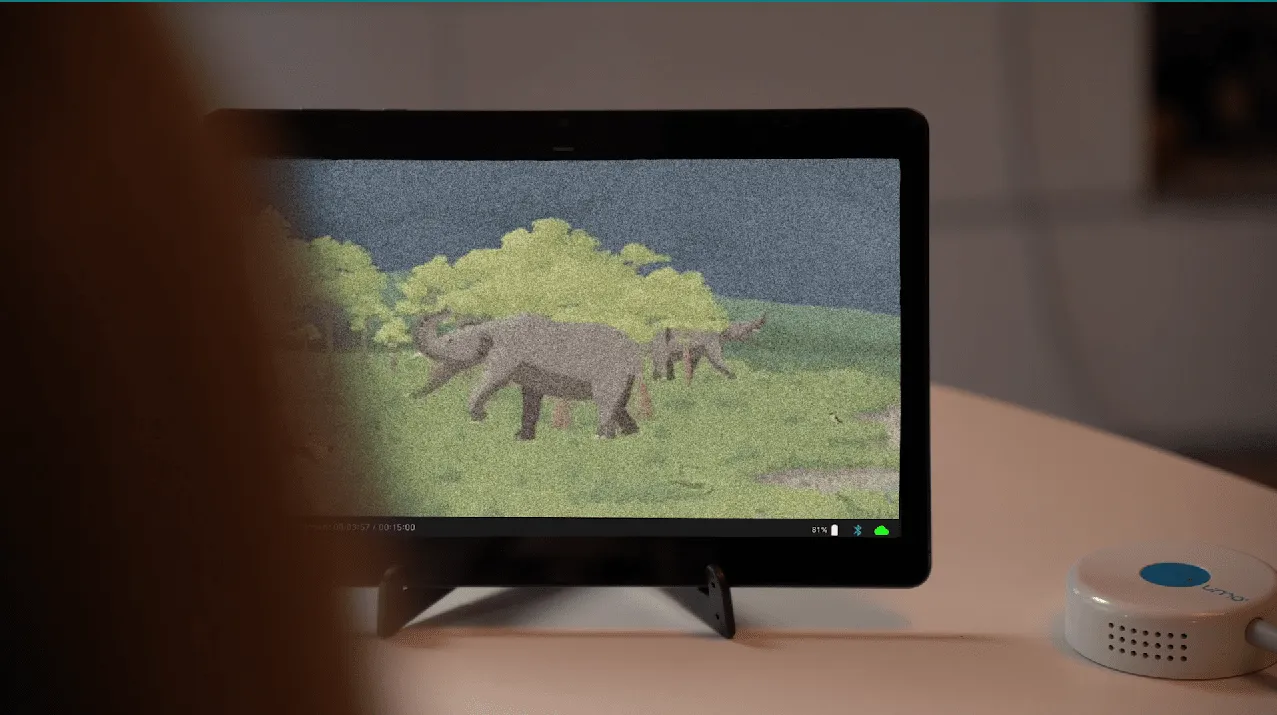
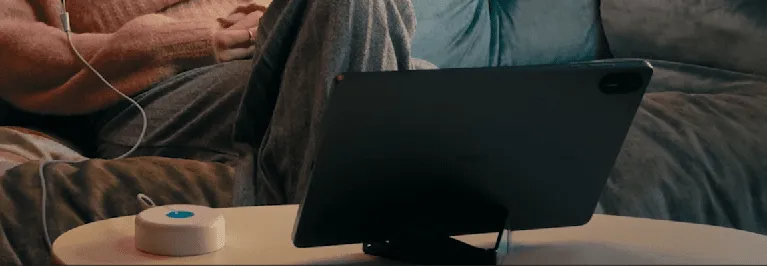
Your only job is to turn on the tablet, turn on Umo, put electrodes on your head (they only capture signals, they don't send any stimulus to your brain), and relax while watching an interesting video.
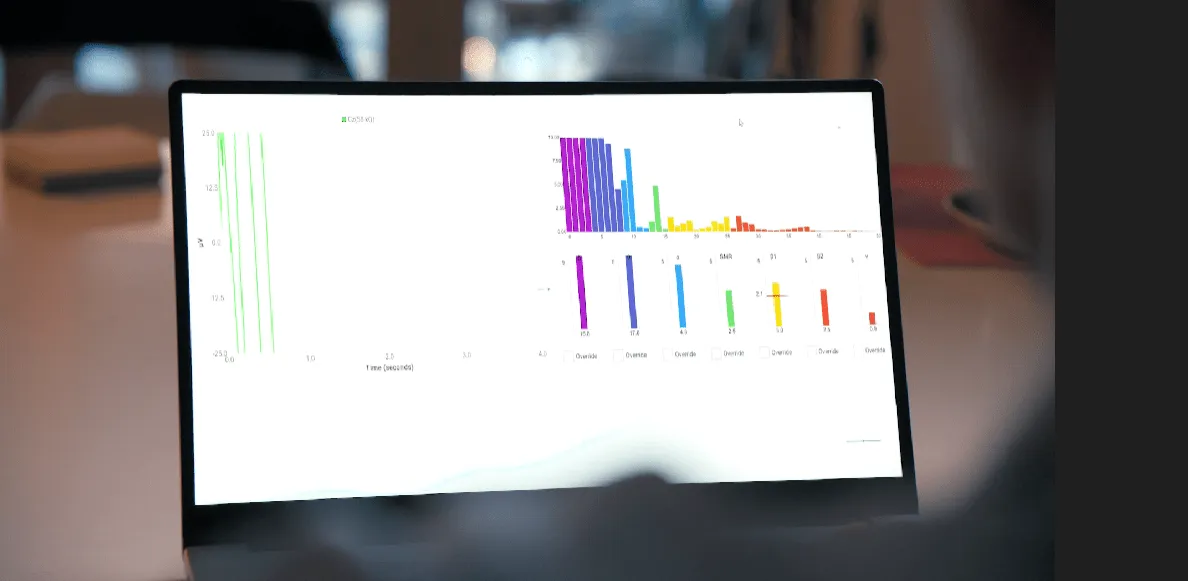
Our team monitors your data and guides your progress remotely. Training sessions last between 15 and 30 minutes and you can train every day, any time of day.
Your only job is to turn on the tablet, turn on Umo, put electrodes on your head (they only capture signals, they don't send any stimulus to your brain), and relax while watching an interesting video.
Our team monitors your data and guides your progress remotely. Training sessions last between 15 and 30 minutes and you can train every day, any time of day.
Evidence-Based Training Protocols
Every brain is unique. Based on your goals and EEG data, our experts select the precise protocol with the highest probability for maximum impact on your mental well-being.
Alpha-Theta
Restorative calm & creative enhancement
Theta/Beta
Sustained attention & focus
Alpha | SMR | Beta
Sleep quality & cognitive drive
Hi-Beta Down
Anxiety reduction & mental calm
Delta Down
Mental clarity & cognitive efficiency
Custom Protocol
Tailored to your unique needs
Professional supervision at every step

Dr. Giuseppe Chiarenza
MD, child psychiatrist and neurologist, BCIA-certified neurofeedback therapist
MD, child psychiatrist, neurologist and psychotherapist, BCIA-certified neurofeedback therapist, with more than 40 years of relevant experience. He designs and supervises the protocols of Umo training and, as part of the specialist analysis, creates individual protocols.
[email protected]
Marin Maletić
MS, BSc EE
A neuroscientist and the creator of the Umo platform. With a background in electrical engineering and the propaedeutics of psychotherapy, Marin oversees the remote monitoring and technical integration of your neurofeedback journey.
[email protected]Dr. Giuseppe Chiarenza
MD, child psychiatrist and neurologist, BCIA-certified neurofeedback therapist
MD, child psychiatrist, neurologist and psychotherapist, BCIA-certified neurofeedback therapist, with more than 40 years of relevant experience. He designs and supervises the protocols of Umo training and, as part of the specialist analysis, creates individual protocols.
Marin Maletić
MS, BSc EE
A neuroscientist and the creator of the Umo platform. With a background in electrical engineering and the propaedeutics of psychotherapy, Marin oversees the remote monitoring and technical integration of your neurofeedback journey.
The Umo Collective
Beyond Giuseppe and Marin, a network of specialists, psychotherapists, and performance coaches stands ready to support you. When your training requires deeper expertise or a broader perspective, the collective steps in, ensuring you are never navigating alone.
Umo partners
















* Names and photos in testimonials have been changed to protect privacy.
Frequently Asked Questions
Neurofeedback is a non-invasive brain training technique that uses real-time EEG monitoring to help you learn to regulate your brain activity. By watching a video that responds to your brainwaves, your brain naturally learns to produce healthier patterns.
Yes and no. When used as part of a strategy to address medical issues like depression, anxiety disorders, or dementia, it can be considered therapy. However, it is fundamentally a training method that helps with various medical conditions, not a medical therapy per se. In medical science, it typically does not have the status of a medication.
The most common choice is 60 days for €800, which with daily training is about €13 per session. For long-term clients, with an extension of €250 a month, a session is about €8.30. The equipment is included in the price.
We recommend training every day, because regularity contributes most to progress. You still set your own pace: a few sessions a week also make sense, and your training supervisor helps you put together a schedule you can keep. Each session lasts 15-30 minutes, at any time that suits your schedule.
Yes. Neurofeedback is completely non-invasive and has been used safely for over 60 years. It simply reads your brain activity and provides feedback - nothing is sent into your brain. It's suitable for children and adults alike.
Not at all. You get a pre-configured tablet on which you watch the video, the Umo device and a cable with electrodes. The cable plugs into Umo with a single connector, and the small electrodes at its other end stick to your head with conductive cream. Turn on both devices, place the electrodes following our simple guide, and start watching. Our team monitors everything remotely.
Most people notice initial changes within 2-4 weeks of regular training. More significant improvements usually develop over 8 to 12 weeks. Your progress is monitored by our team who will adjust your protocol as needed.
Simply return the equipment to us. There's no commitment to purchase anything. If you want to continue, you can extend your subscription.
Neurofeedback is backed by over 60 years of peer-reviewed research. The International Society for Neuroregulation & Research (ISNR) maintains a comprehensive repository of scientific studies demonstrating its efficacy for conditions including ADHD, anxiety, depression, PTSD, and peak performance. Visit isnr.org to explore the research.
No. While EEG provides valuable information about brain activity patterns, it cannot be used alone to precisely diagnose conditions. The EEG signal is one piece of the puzzle that becomes meaningful only when integrated with other case information, your history, and clinical observations. Similarly, we cannot reliably measure progress solely from the signal. The primary indicator of success is your own self-observation of changes in daily life - or in the case of children, parents' observations of behavioral and emotional improvements.
Neurofeedback is brain training, just as exercise is training for the body. When a doctor chooses exercise as part of treatment, it becomes part of therapy, and the same holds for neurofeedback. That is why it is also used in medicine: research and clinical practice report good results in ADHD, specific learning difficulties, anxiety, depression, epilepsy, recovery after stroke or brain injury, the consequences of psychological trauma, and on the autism spectrum. The level of evidence varies from condition to condition. For health conditions, Umo provides training alongside medical supervision, and an individual protocol is designed by Dr Giuseppe Chiarenza, child psychiatrist and neurologist.
When you read that 'more research is needed,' this typically refers to clinical-level evidence. This is extremely difficult to obtain for neurofeedback because it's impossible to conduct the type of studies done for medications - so-called double-blind randomized trials. Even if such studies were possible, they would be financially unjustifiable since this method cannot be patented the way medications are. However, direct clinical experience and the proven physiological mechanisms underlying the method are sufficient for it to be used within medicine.
Why Neurofeedback with Umo?
Neurofeedback has helped people overcome some of life's toughest challenges, from ADHD and anxiety to epilepsy and trauma recovery. At the same time, elite athletes, executives, and performers have used it to sharpen focus and unlock peak mental states. You can find more about the scientific research at isnr.org.
Umo opens the door. Whether you're seeking relief from a condition or striving to perform at your best, you can now train your brain at home, on your schedule, as often as you need. No across-the-city appointments, no fuss with technicalities, just a simple home setup with equipment you borrow from us.
Bridging the gap between the lab and the living room since 2016.
Send an inquiry
We will get back to you within one working day.